lynxking Slip Lead Review: One Piece of Rope That Replaces Collar and Leash
I ordered the lynxking slip lead after my dog figured out how to back out of his flat collar during a walk. He's not a puller, but he's got a narrow head and a talent for escape. A friend who trains dogs suggested a slip lead — not as a correction tool, but as a simple piece of gear that stays on. At $13.49 for an 8-foot heavy-duty rope lead, it was worth finding out whether one piece of rope could replace both collar and leash.
The lynxking arrived as a single continuous loop of 1/2-inch climbing rope with a metal ring at one end. You feed the rope through the ring to create the slip loop, drop it over the dog's head, and the loop tightens or loosens with pressure. There's no buckle, no clasp, no hardware beyond that one ring. The rope itself is thick enough to feel substantial in your hand without being heavy around the dog's neck. The 8-foot length gives plenty of slack for sniffing and exploring without constantly hitting the end.
Are Slip Leads Dangerous, or Just Misused?
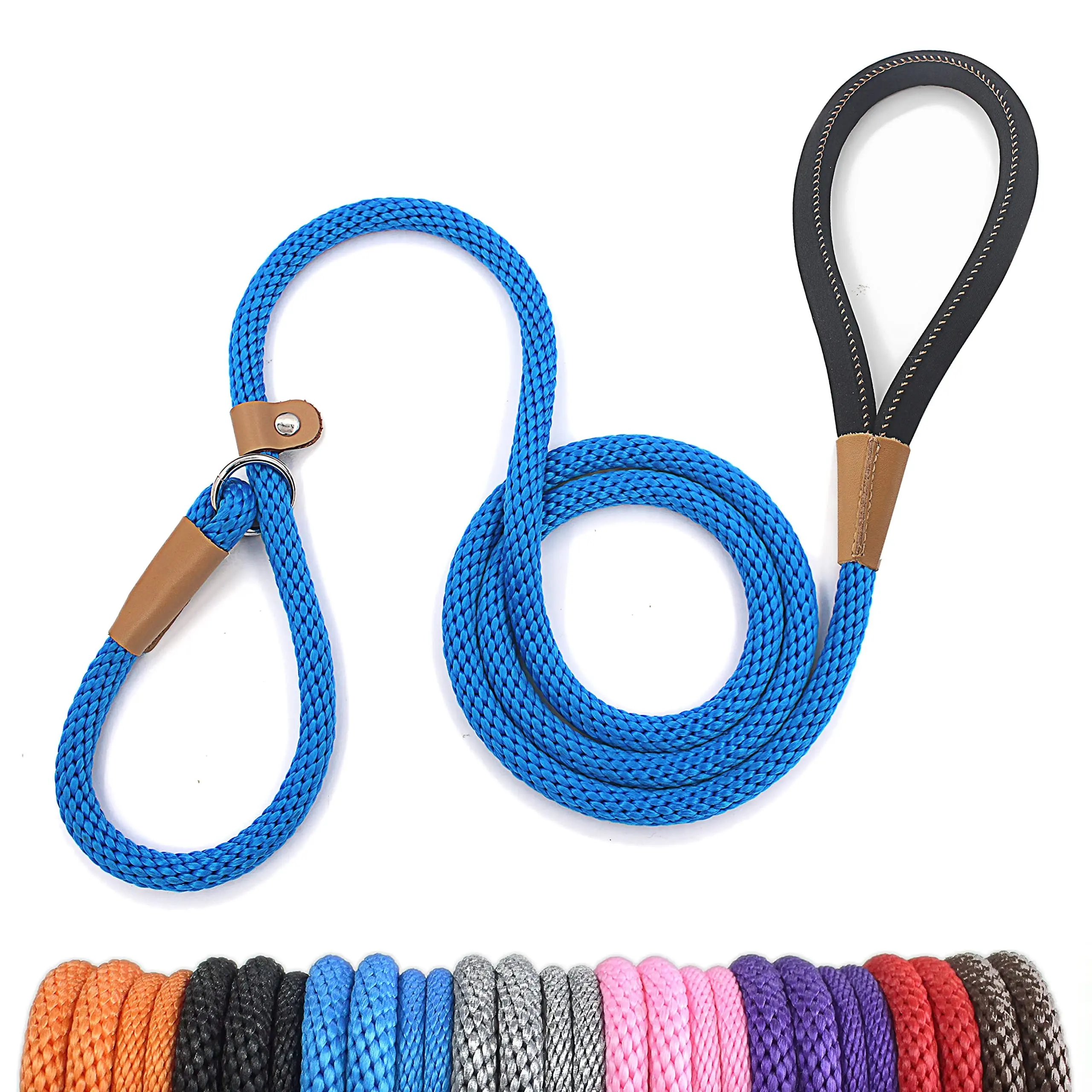
This is the most heated debate in the dog gear world. A lot of people say slip leads should never be used as a training tool — they're for shelters and vets briefly escorting animals, nothing more. The concern is legitimate: a slip lead can tighten indefinitely around a dog's neck. In the wrong hands, that's a choking hazard.
The lynxking has no built-in stopper, which means the loop will close as far as the ring allows. If your dog pulls hard and constantly, this isn't the right tool — you need a martingale with a fixed stop point, or a well-fitted harness. The application of the tool matters more than the tool itself. Used correctly with positive reinforcement, it works really well. In the wrong hands, you can seriously injure your dog.
I use the lynxking on a dog who walks with a loose leash 90% of the time. The loop hangs slack around his neck for most of the walk. When he does pull — usually because a squirrel made a personal appearance — the slip tightens briefly, he feels the pressure, and he eases up. I don't yank. I don't correct. I just stop walking until the pressure releases. He figured out the system in about two walks.
Does a Slip Lead Actually Help With Training?
You can't just stick a slip lead on a dog and expect it to magically change anything. That's where slip leads get a bad reputation. The lead itself doesn't train the dog. What it does is provide clearer feedback than a flat collar — when the dog pulls, they feel pressure around the entire neck, and when they stop pulling, the pressure releases instantly. A flat collar distributes pull force across a narrow strip at the front of the throat. A properly fitted slip lead spreads it evenly around the neck above the trachea.
The key is positioning: the slip loop needs to sit high on the neck, right behind the ears and just below the jaw bone — above the trachea. If the loop drops down to mid-neck, it puts pressure directly on the trachea, which is both uncomfortable and unsafe. The lynxking's 1/2-inch rope diameter helps here — a thinner lead concentrates pressure into a smaller area. The thicker rope spreads it out.
One thing that took me a few walks to get right: the position of the loop changes everything. When the lead sits high at the top of the neck behind the ears, the dog feels gentle pressure distributed evenly around the whole neck rather than concentrated on the front of the throat. The loop should hang completely slack during normal walking — if there's tension when the dog is just standing there, it's either too low or too tight.

I learned something unexpected while using this lead: my dog, who's afraid of buckles and clasps after an accident with a harness, is completely relaxed around the slip lead. It doesn't involve any hardware near his body, so there's nothing to trigger his fear. For dogs with handling sensitivities, the simplicity of a slip lead is a feature, not a compromise.
Pros, Cons, and Verdict
What I liked: the rope quality is excellent — soft enough to handle comfortably, strong enough that I never worry about it failing. The 8-foot length is perfect for sniff-walks where the dog sets the pace. The simplicity is the selling point — no buckles, no clasps, nothing to break or fumble with. It packs down to nothing and lives in my car for spontaneous trail stops.
What I didn't love: the lack of a built-in stopper means you have to pay attention to loop position throughout the walk. The 1/2-inch rope is fine for my 55-pound dog but might be overkill for a 15-pound terrier. And this is absolutely not the right tool for a dedicated puller — if your dog drags you down the street, get a front-clip harness and work on loose-leash foundations first. A slip lead is a tool for dogs who already know what leash pressure means, not the thing that teaches them.
The lynxking slip lead is a simple, well-made piece of gear for dogs who walk nicely most of the time and just need a reliable connection to their handler. It's not a training shortcut. It's not a correction device. It's one continuous piece of rope that does exactly what it's supposed to do — no more, no less. If you prefer a collar-only setup, check out our dog collar with built in lead for a different take on simplifying your walk gear.
lynxking Slip Lead Dog Leash
Heavy-duty 8ft rope slip lead — integrated collar and leash, 1/2-inch climbing rope.
View Product — $13.49If your dog walks nicely and you want to carry one piece of gear instead of two, the lynxking delivers. If your dog still pulls, start with training — the right tool for that is patience, not rope.
| Product Specs | |
|---|---|
| Brand | lynxking |
| Type | Slip Lead (Integrated Collar + Leash) |
| Length | 8 Feet |
| Diameter | 1/2 inch Climbing Rope |
| Material | Heavy-Duty Nylon Rope |
| Best For | Loose-leash trained dogs, escape artists |
| Rating | 4.5 / 5 (13,800+ reviews) |
One piece of rope. Used right, that's all you need.